
EPS vs PIR vs Rockwool.
Same panel, three cores — different cost, insulation and fire behaviour. Here’s how to pick, with the numbers to back it.
What matters most to you?
Start from your priority — it points to the right core.
The three cores
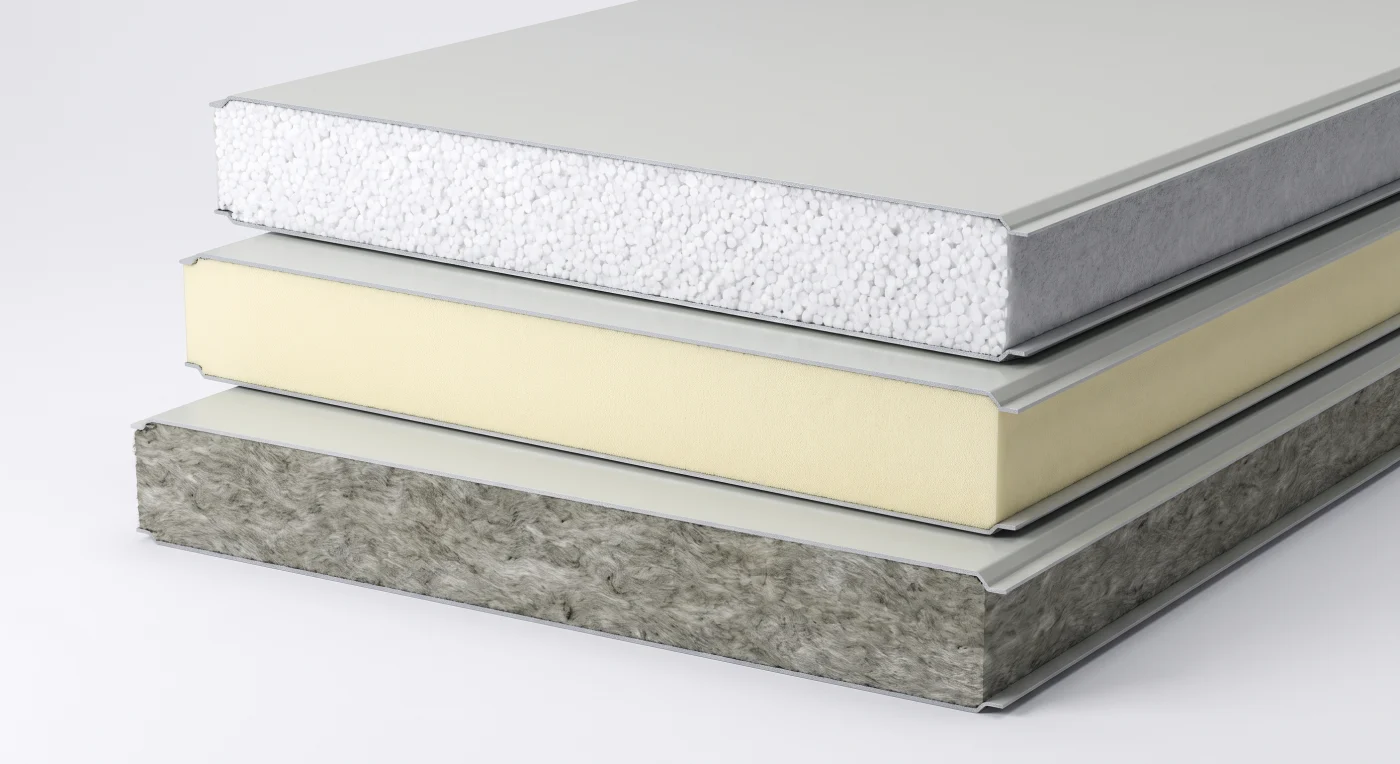
Core comparison at a glance
| Core | Thermal conductivity (λ) | Approx R-value @100mm | Fire behaviour | Core density | Relative cost |
|---|---|---|---|---|---|
| EPS Expanded polystyrene |
~0.037 W/m·K | ~R2.6 | Combustible; fire-retardant (FR) grades available | ~13–20 kg/m³ | $ — lowest |
| PIR Polyisocyanurate |
~0.022 W/m·K | ~R4.5 | Combustible but chars/self-extinguishes; better than standard EPS | ~35–40 kg/m³ | $$$ — highest |
| Rockwool Mineral wool |
~0.038 W/m·K | ~R2.6 | Non-combustible mineral core; best fire & acoustic rating | ~90–120 kg/m³ | $$ — mid |
Which one should you choose?
Choose EPS
For cool rooms, sheds, partitions and modular rooms where cost matters and standard insulation is enough. The most economical and lightest option — the default for most cool-room builds.
Choose PIR
When you need the most insulation from the least thickness — freezers, cold storage and tight wall build-ups. Roughly double the R-value of EPS per millimetre — the highest-priced core, but the most compact.
Choose Rockwool
Where a non-combustible core, fire compliance or acoustic performance is required. Heaviest, mid-priced, but the safest choice for stricter fire ratings.
Comparison questions
Which panel has the best insulation?
PIR has the lowest thermal conductivity (~0.022 W/m·K), so it delivers the highest R-value for a given thickness — roughly double that of EPS or Rockwool. A thinner PIR panel can match a thicker EPS one, useful where wall build-up is limited.
Which is best for fire safety?
Rockwool (mineral wool) is non-combustible and generally achieves the best fire rating. PIR chars and resists flame spread better than standard EPS. Standard EPS is combustible, so fire-retardant (FR) grades and correct detailing matter — always check the panel’s fire rating against your NCC / BCA requirements.
Why is EPS the most common for cool rooms?
EPS offers the best balance of insulation, weight and cost for typical cool rooms, food storage, sheds and modular rooms. Unless the project needs maximum thermal performance (PIR) or strict fire compliance (Rockwool), EPS is usually the practical choice.
Size it, then get a quote
Use the calculator for panel counts, then send your spec to Cool Room Master.